
The Eighth Commandment: You Shall Not Bear False Witness Against Your Neighbor
What Does the Eighth Commandment Require?
The Importance of the Eighth Commandment in Modern Society
The Eighth Commandment requires truthfulness in speech and action, protecting truth as foundational to human relationships, society, and relationship with God. The Catechism teaches that the eighth commandment forbids misrepresenting the truth in our relations with others and that offenses against truth express by word or deed a refusal to commit oneself to moral uprightness (CCC, 2464, 2468). This commandment governs all communication, requiring honesty, discretion, and respect for others’ reputations.
Truth-telling serves multiple essential goods: personal integrity, trust in relationships, justice in society, and proper understanding of reality. Lying, even about seemingly trivial matters, damages these goods by injecting falsehood into human discourse. St. Augustine taught that every lie is a sin because it abuses the faculty of speech, which God gave humans for communicating truth. Even lies intended to help others or avoid harm remain lies and violate the commandment, though circumstances may diminish culpability.
The commandment prohibits various forms of deception:
- outright lies (affirming as true what is false),
- mental reservation without just cause (intentionally misleading),
- false testimony in legal contexts,
- perjury (lying under oath),
- slander (false statements harming reputation),
- detraction (revealing true faults unnecessarily),
- rash judgment (assuming the worst about others), and
- gossip (spreading information about others).
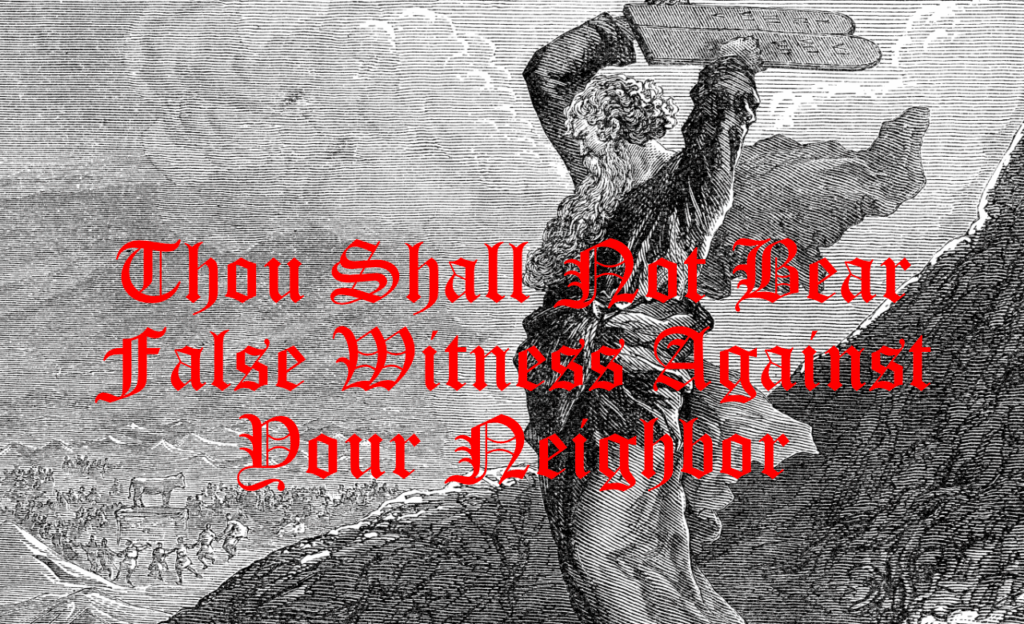
It requires discretion in speaking, respecting others’ right to privacy, and maintaining appropriate silence about confidential matters.
However, truth-telling must be balanced with prudence. The Catechism teaches that no one is bound to reveal the truth to someone who does not have the right to know it (CCC, 2489). This means that legitimate secrets may be kept, privacy may be protected, and complete disclosure is not always required. Professional secrets like doctor-patient confidentiality, attorney-client privilege, and seal of confession receive special protection. The key distinction is between withholding truth appropriately and actively deceiving through falsehood.
How Has Social Media Created New Forms of False Witness?
Social media platforms have created unprecedented opportunities for Eighth Commandment violations through viral misinformation, defamation, false self-presentation, and destruction of reputations. The speed and reach of digital communication amplify falsehood’s damage exponentially, allowing lies to spread globally before corrections can take effect. A landmark 2018 MIT study analyzing 126,000 news stories shared on Twitter found that false information spreads six times faster than true information and reaches far more people (Vosoughi et al., 2018).
Facebook, Twitter, Instagram, and TikTok facilitate character assassination through unverified accusations, decontextualized videos, and coordinated harassment campaigns. The 2019 case of Covington Catholic high school student Nick Sandmann illustrates social media mob justice dangers. A brief video clip appeared to show Sandmann smirking at a Native American elder during a confrontation, sparking immediate viral outrage. Millions shared the video with commentary condemning Sandmann as racist. Death threats poured in. Media outlets published his name and image alongside denunciations. Only after fuller context emerged did the narrative shift, revealing the initial portrayal as misleading. Sandmann successfully sued multiple media outlets for defamation, settling for undisclosed amounts (Fung, 2020).
The post-truth era concept emerged recognizing that many now treat truth as irrelevant or subordinate to emotional appeal and tribal identity. When Oxford Dictionaries selected post-truth as 2016 Word of the Year, they defined it as circumstances in which objective facts are less influential than appeals to emotion. This cultural shift represents grave threat to truth itself, making the Eighth Commandment’s call to honesty counter-cultural witness.

Catholics must practice digital temperance and honesty by verifying information before sharing, refusing to participate in online mob behavior, taking responsibility for content amplified through sharing or liking, protecting others’ reputations, avoiding gossip masked as prayer requests, and being willing to correct mistakes publicly.
St. James warned that the tongue is a fire, a world of unrighteousness… setting on fire the entire course of life (James 3:6). Social media amplifies the tongue’s destructive potential exponentially, requiring heightened vigilance.
What About Lying to Protect Privacy or Prevent Harm?
Catholic moral theology recognizes limited circumstances where withholding truth or speaking ambiguously may be morally permissible, but never formal lying—deliberately affirming as true what one knows to be false. The principle of mental reservation allows responding to unjust questions with truthful but incomplete answers when the questioner has no right to full information. St. Augustine distinguished between lies (always wrong) and concealment (sometimes permissible).
The classic example involves hiding persecuted individuals. If Nazis knock asking if you are hiding Jews, you have no obligation to provide information enabling murder. Possible responses include: I’m not going to help you find anyone (truthful refusal); There is no one here (using narrow mental reservation where here means visible in this room); or even responding ambiguously to misdirect without formally lying. The principle is that unjust aggressors have no right to information that aids their evil purposes.
However, situations genuinely justifying such evasion remain rare. Most claims of necessity for lying involve convenience rather than true moral conflict. Doctors do not face Gestapo-like situations when discussing diagnoses; they face patients who deserve truth. Spouses do not face murderous interrogators; they face partners deserving honesty. Businesspeople do not face existential threats; they face competitive pressures that do not justify fraud. The temptation is to expand exceptions until they swallow the rule.
In practice, Catholics should cultivate habitual truthfulness while recognizing occasional tensions between truth-telling and other goods like protecting innocent life. These tensions require prudential judgment formed by prayer, consultation with spiritual directors, and careful attention to Church teaching. The presumption must always favor truth-telling, with departures justified only by gravest necessity. Developing character that naturally speaks truth, even when costly, remains the goal.
How Does Advertising Systematically Violate Truth?
Commercial advertising frequently violates the Eighth Commandment through deceptive claims, manipulative techniques, and creation of false needs. The Catechism notes that advertising can become an instrument of abuse when it promotes false values, encourages excessive consumption, or presents distorted views of reality (CCC, 2496). Much contemporary advertising crosses these boundaries systematically, treating truth as obstacle to sales rather than moral requirement.
More subtle are advertising techniques that manipulate through association rather than explicit claims. Alcohol advertisements featuring attractive people in exciting situations create false associations between drinking and desirable lifestyles without literally claiming alcohol causes happiness or popularity. Pharmaceutical companies advertise directly to consumers, creating demand for unnecessary medications through fear and manufactured concerns about conditions that may not require treatment. Advertising to children exploits their developmental inability to recognize persuasive intent.
The advertising industry spends over $250 billion annually in the United States alone to shape desires and perceptions. This massive investment in influencing behavior raises moral questions about manipulation even when individual ads avoid explicit falsehood.
Catholics should approach advertising with critical skepticism, recognizing its systematic bias toward consumption and material solutions. Parents must help children develop media literacy about advertising’s manipulative techniques. Supporting honest businesses and avoiding companies that systematically deceive demonstrates commitment to truth. Additionally, Catholics in advertising professions face particular responsibilities to refuse creating deceptive campaigns even at professional cost.
What About Professional Secrets and Confidentiality?
The Eighth Commandment requires respecting legitimate professional secrets and confidential information. Doctors, lawyers, therapists, and clergy receive confidential information as part of their professional duties and have moral obligations to maintain confidentiality. The Catechism teaches that professional secrets must be kept, save in exceptional cases where keeping the secret is bound to cause very grave harm (CCC, 2491).
The seal of confession receives absolute protection in Catholic teaching. No circumstance whatsoever justifies a priest revealing what he heard in sacramental confession. The Catechism states that the sacramental seal is inviolable; therefore, it is a crime for a confessor in any way to betray the penitent by word or in any other manner or for any reason (CCC, 2490). This protection allows penitents to confess serious sins without fear, enabling sacramental grace to flow freely.
Some jurisdictions have attempted to force priests to violate confession’s seal through mandatory reporting laws. Several U.S. states require clergy to report child abuse learned through any means, with some explicitly refusing to exempt confession. The Church maintains that priests must refuse such laws even at cost of imprisonment, as divine law supersedes human law. The 2018 case of Australian priest Father John Fleming facing contempt charges for refusing to violate seal illustrates these conflicts (Chamberlin, 2018).
Medical confidentiality protects patient privacy and enables honest disclosure necessary for proper treatment. Patients must trust that sensitive information shared with doctors will not be disclosed without consent. HIPAA regulations provide legal framework protecting health information. However, confidentiality has limits when patients pose serious threats to others. If a patient credibly threatens to kill someone specific, doctors may have obligations to warn potential victims.
Conclusion: Truth as Foundation for Human Flourishing
The Eighth Commandment stands as essential defense against post-truth culture that treats objective reality as subordinate to tribal identity and emotional appeal. From viral misinformation spreading six times faster than truth on social media to systematic deception in advertising, from gossip destroying reputations to violations of professional confidentiality, contemporary society demonstrates widespread erosion of truthfulness. The commandment requires more than merely avoiding outright lies; it demands positive cultivation of honesty, protection of others’ reputations, respect for legitimate privacy, and recognition that truth serves as non-negotiable foundation for human relationships and social order. When lying becomes normalized, trust erodes, relationships fracture, justice becomes impossible, and society descends into competing narratives where power determines accepted reality rather than objective truth.
Living this commandment authentically requires transformation at individual, institutional, and societal levels. Individually, Catholics must examine consciences for lies, gossip, detraction, rash judgment, and social media sharing without verification, making amends through corrections and changed behavior.
Institutionally, organizations must prioritize truthfulness over image management or profit maximization—businesses advertising honestly, news organizations verifying stories thoroughly, and religious institutions acknowledging failures rather than concealing abuse.
Societally, Catholics must advocate for structures supporting truthfulness: media literacy education, regulation of deceptive advertising, and cultivation of civic culture valuing truth over tribal loyalty.
Ultimately, the Eighth Commandment invites recognition that truth finds its source in God himself, who is Truth. Jesus declared, “I am the way, and the truth, and the life” (John 14:6). To violate this commandment by lying constitutes theological rebellion against the God who cannot lie. Conversely, speaking truthfully participates in divine nature, imaging the God whose Word is eternally faithful. When Catholics refuse to lie despite cost, protect reputations against gossip, verify information before sharing, and maintain professional confidences under pressure, they witness to transcendent Truth beyond cultural relativism. This counter-cultural witness becomes increasingly necessary as society abandons shared commitment to objective reality accessible through reason and evidence.
References
Augustine of Hippo. (395). On lying. New Advent.
Catechism of the Catholic Church. (2nd ed.). (2000). Libreria Editrice Vaticana.
Chamberlin, P. (2018, August 15). Australian priest and confession seal. Crux.
Francis. (2013). Evangelii gaudium. Vatican.
Fung, K. (2020, January 8). Nick Sandmann settles lawsuit. CNN.
Silverman, C. (2016, November 16). How fake news outperformed real news. BuzzFeed News.
Vosoughi, S., Roy, D., & Aral, S. (2018). The spread of true and false news online. Science, 359(6380), 1146-1151.