
“You’re Breaking This Commandment 100 Times a Day (And Don’t Even Know It)”
You Shall Not Take the Name of the Lord Your God in Vain
What Does the Second Commandment Mean?
The Second Commandment requires reverence for God’s name and all that is sacred. According to the Catechism of the Catholic Church, “The second commandment prescribes respect for the Lord’s name. Like the first commandment, it belongs to the virtue of religion and more particularly it governs our use of speech in sacred matters” (CCC, 2142). God’s name represents His very essence and presence; therefore, misusing it constitutes a grave offense against His majesty and holiness.
In ancient Israel, God’s name held profound significance. When God revealed His name to Moses as “I AM WHO AM” (Exodus 3:14), He disclosed His eternal, self-existent nature. The Hebrew name YHWH (Yahweh) was considered so sacred that devout Jews would not pronounce it, substituting “Adonai” (Lord) instead (CCC, 2143). This practice reflects the commandment’s core principle: God’s name must be treated with utmost respect because it represents His divine person.
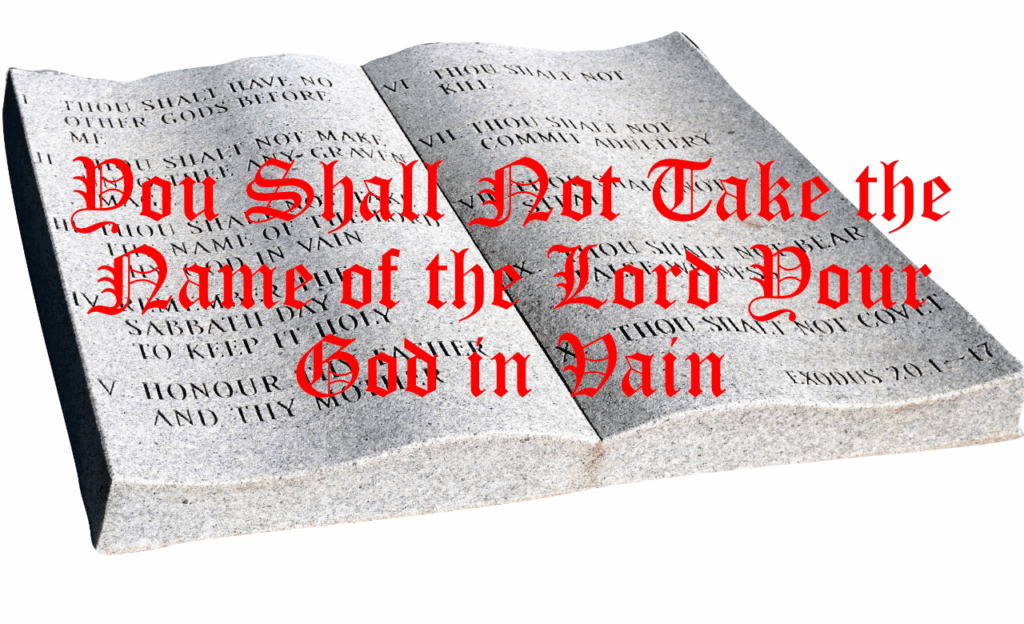
The commandment prohibits several specific offenses: blasphemy (speaking against God with hatred or reproach), perjury (calling upon God to witness a lie), and vain invocation (using God’s name carelessly without reverence). Additionally, it forbids magic practices that misuse God’s name and requires careful respect when naming religious objects, people, and places (CCC, 2146-2155).
How Do We Show Reverence for God’s Name in Daily Life?
Practicing the Second Commandment begins with conscious awareness of how we use language. Catholics should cultivate habitual reverence by beginning prayers and conversations about faith matters with phrases like “In the name of the Father, and of the Son, and of the Holy Spirit” or “Praised be Jesus Christ.” When hearing God’s name spoken, one might bow their head slightly as a sign of interior reverence, a practice common in traditional Catholic culture (Guardini, 2013).
Invoking God’s name appropriately includes blessing others (“God bless you”), seeking divine assistance (“God help me”), expressing gratitude (“Thank God”), and witnessing to faith (“As God is my witness”). These uses honor the commandment because they acknowledge God’s active presence and sovereignty. St. Paul instructed, “And whatever you do, in word or deed, do everything in the name of the Lord Jesus, giving thanks to God the Father through him” (Colossians 3:17), teaching that proper invocation sanctifies human activity.
Teaching children reverence for God’s name requires parental modeling. Parents should never use God’s name carelessly or profanely in front of children, as this normalizes disrespect. Instead, families can practice blessing meals with: “Bless us, O Lord, and these Thy gifts…” and ending with “in the name of the Father, and of the Son, and of the Holy Spirit.” When children hear God’s name used disrespectfully by others, parents should explain why this troubles faithful Catholics (Cavins & Walz, 2015).
St. Padre Pio (1887-1968) exemplified Second Commandment faithfulness through his constant reverence. He reportedly would bow his head every time he heard Jesus’ name, and witnesses observed him becoming visibly distressed when others used God’s name carelessly. His example demonstrates that interior reverence naturally manifests in external actions and emotional responses (Ruffin, 1991).
What Constitutes Blasphemy in Contemporary Society?
Blasphemy, the most serious violation of the Second Commandment, involves “uttering against God—inwardly or outwardly—words of hatred, reproach, or defiance” (CCC, 2148). Modern culture increasingly normalizes blasphemous language through entertainment media, casual conversation, and online discourse. Television shows and films routinely use “Jesus Christ” or “God” as exclamations of frustration, shock, or anger, habituating audiences to disrespectful usage.
The entertainment industry presents particularly egregious examples. The 2013 film “This Is the End” featured numerous instances where Jesus Christ’s name was used profanely for comedic effect, with the name appearing as an expletive over 50 times (Box Office Mojo, 2013). Similarly, many popular television series on streaming platforms include blasphemous language in nearly every episode, presenting such speech as normal rather than offensive. A 2019 Parents Television Council study found that broadcast television blasphemy increased by 600% between 2005 and 2019 (Parents Television Council, 2019).
Social media amplifies blasphemy’s reach. Twitter, Instagram, and TikTok contain countless posts using God’s name profanely, often in contexts mocking religious belief. Hashtags like #goddammit trend regularly with millions of posts, indicating widespread casual blasphemy. The anonymity and distance of online communication lower inhibitions that might otherwise restrain disrespectful speech (Crockett, 2017).
More insidious are forms of intellectual blasphemy that attack God’s character or existence. The “New Atheism” movement, represented by figures like Richard Dawkins and Christopher Hitchens, published bestselling books explicitly mocking religious belief and portraying God as malevolent or fictional. Dawkins’ “The God Delusion” (2006) sold millions of copies and spawned a cultural movement treating religious faith as intellectual weakness. While criticism of religion may constitute free speech, Catholics recognize that mockery of God Himself crosses into blasphemy.
Artistic blasphemy presents particular challenges. Works like Andres Serrano’s “Piss Christ” (1987), a photograph of a crucifix submerged in urine, or Chris Ofili’s “The Holy Virgin Mary” (1996), depicting Mary with elephant dung, generated controversy precisely because they deliberately profaned sacred images. Defenders invoke artistic freedom, but the Catholic perspective recognizes these as calculated insults to divine persons and holy objects (Pattison, 2015).
How Does Casual Profanity Violate the Second Commandment?
Beyond explicit blasphemy, casual profanity represents a more common Second Commandment violation. When people use “Oh my God,” “Jesus Christ,” or “God” as exclamations without invoking divine assistance or expressing genuine reverence, they violate the commandment through vain usage. The Catechism states: “The second commandment forbids… every improper use of God’s name… misuse shows a lack of respect for the Lord” (CCC, 2146).
Workplace culture often normalizes casual profanity. Many professionals routinely use God’s name as verbal filler or emphasis without conscious awareness. For example, business meetings may include phrases like “Oh my God, that’s a great idea” or “Jesus, we need to fix this problem.” While speakers may intend no disrespect, the casual invocation treats God’s name as ordinary speech rather than sacred reality (Quinn, 2016).

Text messaging and social media abbreviations compound the problem. “OMG” (Oh My God) has become so ubiquitous that many users type it reflexively without considering its meaning. The abbreviation appears billions of times daily across digital platforms, representing perhaps the most frequent Second Commandment violation in human history. Its very commonality demonstrates how desensitization occurs—repeated exposure to irreverent usage numbs recognition of offense.
Catholics navigating secular environments face pressure to conform to profane speech patterns. Choosing alternative expressions—”Oh my goodness,” “Goodness gracious,” “My word”—may seem awkward or old-fashioned but demonstrates commitment to the commandment. Some Catholics substitute “cheese and rice” or similar euphemisms, though purists note these still reference sacred names indirectly and should be avoided (Kreeft, 2015).
What Is Perjury and How Does It Violate This Commandment?
Perjury—lying under oath while invoking God as witness—constitutes a grave Second Commandment violation. The Catechism teaches: “A false oath calls on God to be witness to a lie. Perjury is a grave offense against the Lord who is always faithful to his promises” (CCC, 2152). Court proceedings traditionally require witnesses to swear oaths invoking God, making perjury not merely legal fraud but sacrilege.
The gravity of perjury extends beyond courtrooms. Making false promises while invoking God’s name constitutes similar offense. When people say “I swear to God” to strengthen false claims, they call God to witness lies. This occurs frequently in casual conversation when individuals attempt to convince others of dubious statements by invoking divine witness falsely.
Catholic teaching on oaths emphasizes their sacred nature. Jesus taught, “Let your ‘Yes’ mean ‘Yes,’ and your ‘No’ mean ‘No.’ Anything more is from the evil one” (Matthew 5:37), suggesting that truthfulness should not require oaths. However, when legitimate authority requires oaths for serious purposes—court testimony, citizenship ceremonies, professional vows—Catholics must take them with full awareness of their sacred binding nature (CCC, 2153-2154).
How Do Magic and Superstition Violate the Second Commandment?
The Second Commandment prohibits using God’s name in magical or superstitious practices. The Catechism states: “The second commandment forbids… all practices of magic or sorcery, by which one attempts to tame occult powers, so as to place them at one’s service” (CCC, 2117). When people invoke God’s name as a magical formula to manipulate supernatural forces, they treat the divine name as a tool rather than honoring God as sovereign Lord.
Contemporary occult practices frequently misuse Christian symbols and divine names. Wiccans and practitioners of ceremonial magic often incorporate “God,” “Jesus,” or “Holy Spirit” into spells and rituals, treating these sacred names as power words divorced from their true referents. The popular “Law of Attraction” teaching, promoted through books like “The Secret” (Byrne, 2006), sometimes includes Christian terminology while advocating that humans can manipulate universal forces through mental techniques—a subtle form of magic disguised as spirituality.
Superstitious use of religious objects also violates this commandment. When people treat blessed items—rosaries, medals, holy water—as lucky charms providing automatic protection independent of faith and prayer, they reduce sacred signs to superstition. While Catholics may certainly ask God’s blessing on various endeavors, attributing magical causative power to religious objects misunderstands their proper sacramental purpose.
Prosperity gospel teachings sometimes border on magical thinking about God’s name. When preachers instruct followers to “claim” wealth or healing by repeatedly invoking Jesus’ name according to specific formulas, they reduce divine invocation to incantation. God responds to genuine prayer offered in faith, not to mechanistic verbal techniques. The Catechism distinguishes authentic prayer—which submits to God’s will—from attempts to coerce divine power through ritual formulas (CCC, 2111).
What About Religious Naming and Baptism?
The Second Commandment has important implications for Christian naming practices. Catholic tradition encourages giving children saints’ names at baptism, establishing spiritual patronage and modeling faithful witness. The Catechism teaches that “the Christian receives his name in the Church. Parents, godparents, and the pastor are to see that a name is not given which is foreign to Christian sentiment” (CCC, 2156). This practice honors the commandment by associating human identity with sacred heritage.
Traditional Catholic practice included selecting confirmation names, allowing adolescents to choose additional saints as spiritual patrons. Popular choices include biblical figures (Mary, Joseph, Peter, Paul) and beloved saints (Francis, Therese, Anthony, Rita). This naming establishes ongoing relationships with holy intercessors while expressing reverence for sacred persons (Bunson et al., 2014).
Contemporary naming practices sometimes conflict with Second Commandment reverence. Celebrities occasionally give children names that frivolously reference sacred titles or divine attributes. When parents name children “Messiah” (a name that appeared 368 times in Social Security Administration data in 2019), they may intend honor but risk irreverence by applying exclusive divine titles to humans (Social Security Administration, 2020). The name “Jesus” remains extremely rare in American culture precisely because of Second Commandment sensitivity, though it’s common in Hispanic cultures where naming honors Christ with full awareness of the name’s sacredness.
Baptism itself involves solemn invocation of the Trinity’s name. The minister baptizes “in the name of the Father, and of the Son, and of the Holy Spirit,” invoking divine names with ultimate seriousness to effect the sacrament. This sacred naming establishes the baptized person’s identity as God’s adopted child and incorporates them into the Church (CCC, 2156). The reverence required during baptism reflects the Second Commandment’s demand for respect whenever divine names are spoken.
How Should Catholics Respond to Blasphemy in Media?
Catholics face difficult choices about engaging media containing blasphemy. The ubiquity of irreverent language in contemporary entertainment means complete avoidance would require cultural withdrawal. However, consistent exposure to blasphemy desensitizes conscience and implicitly approves disrespect for God. Catholics must find balanced approaches that avoid both scrupulosity and complacency.
Some Catholics practice selective consumption—accepting occasional blasphemy in otherwise valuable content while rejecting gratuitous or celebratory profanity. For example, watching a historically accurate war film that contains soldiers’ realistic profanity differs from consuming comedy that mocks God for entertainment. Intent and context matter when evaluating media choices. The U.S. Conference of Catholic Bishops’ Office for Film and Broadcasting provides guidance on media content, helping Catholics make informed decisions (USCCB, 2021).
Active responses to media blasphemy include: contacting networks or studios to express concerns; supporting and recommending faith-friendly entertainment alternatives; using parental controls to shield children from inappropriate content; and engaging social media constructively when blasphemous content goes viral. The Catholic League for Religious and Civil Rights has successfully pressured companies to remove offensive content through organized campaigns (Donohue, 2018).
When encountering blasphemy, Catholics can privately offer prayers of reparation. The traditional Act of Reparation includes: “May the most holy, most sacred, most adorable, most incomprehensible and unutterable Name of God be always praised, blessed, loved, adored and glorified in Heaven, on earth, and under the earth.” This prayer transforms negative encounters with blasphemy into opportunities for increased devotion.
What Is the Connection Between This Commandment and Prayer?
The Second Commandment intimately connects to authentic prayer life. While it prohibits misusing God’s name, it implicitly encourages proper usage through reverent invocation. Prayer fundamentally consists of addressing God by name with awareness that doing so enters His presence. The Lord’s Prayer begins “Our Father” and continues “hallowed be thy name,” teaching that reverencing God’s name constitutes prayer’s foundation (CCC, 2807-2815).
Jesus’ name holds particular power in Christian prayer. Scripture promises: “Whatever you ask in my name, I will do it” (John 14:13). This doesn’t mean mechanically appending “in Jesus’ name” to requests, but rather praying in accord with Jesus’ character and mission. Authentic invocation of Jesus’ name involves union with His will, not manipulation of divine power (Cantalamessa, 2007).
Contemplative prayer traditions emphasize constant repetition of Jesus’ name as spiritual practice. The Jesus Prayer—”Lord Jesus Christ, Son of God, have mercy on me, a sinner”—developed in Eastern Christianity as a method for fulfilling Paul’s instruction to “pray without ceasing” (1 Thessalonians 5:17). Practitioners synchronize the prayer with breathing, creating continuous interior invocation of Jesus’ name. This tradition demonstrates how the Second Commandment encourages rather than restricts divine name usage when offered with reverence (Ware, 1997).
Liturgical prayer saturates Catholic worship with reverent divine invocation. Every Mass includes dozens of references to God’s name in gloria, creed, eucharistic prayer, and dismissal. The Sacred Liturgy models appropriate usage, teaching participants to speak God’s name with consciousness of encountering divine presence. Regular Mass attendance trains Catholics in Second Commandment faithfulness through immersion in reverent language patterns.
How Can Catholics Develop Greater Reverence for God’s Name?
Cultivating reverence requires intentional practice and habit formation. Begin by noticing how often you use God’s name—in prayer, in casual conversation, as exclamation, or as emphasis. Keep a mental tally for one day to build awareness. Most people discover they invoke divine names far more frequently and casually than realized. This awareness creates foundation for change.
Replace casual divine invocations with alternative expressions. Instead of “Oh my God,” try “Oh my goodness” or “My word.” Rather than “Jesus Christ!” as expletive, say “Goodness!” or simply pause before speaking. Initially this feels awkward, but habit forms through consistent practice. After several weeks, alternative expressions become natural while casual divine names begin sounding jarring—evidence of restored sensitivity (Pieper, 1990).
Practice interior acts of reverence when hearing God’s name. Bow your head slightly when “Jesus” is spoken in reverent context. Make a small sign of the cross when the Trinity is invoked. These physical gestures engage the body in worship while reinforcing awareness of the sacred. Over time, such practices become automatic responses that deepen interior reverence.
Meditate regularly on the meaning of God’s names. Scripture reveals divine names that express God’s attributes: Yahweh (I AM), Adonai (Lord), El Shaddai (God Almighty), Abba (Father). Understanding these names’ theological significance increases appreciation for their sacredness. The Catechism’s treatment of divine names (CCC, 203-213) provides excellent meditation material.
Consider adopting devotions that honor Jesus’ name specifically. The Holy Name Society, founded in 15th-century Italy and approved by multiple popes, promotes reverence for Jesus’ name through prayer, reparation for blasphemy, and public witness. Members commit to avoiding profanity and promoting respectful usage of God’s name in their spheres of influence (Holy Name Society, 2022).
Conclusion: Honoring the Sacred Name
The Second Commandment calls believers to recognize that language about God matters profoundly. Words shape reality, and casual, irreverent, or malicious usage of God’s name corrodes both individual souls and cultural spiritual health. In an age of ubiquitous blasphemy and casual profanity, faithful Catholics must countercurally resist linguistic patterns that treat the sacred as ordinary.
Keeping this commandment requires vigilance against personal habits, courage to differ from surrounding culture, and positive cultivation of reverent speech. It demands examination of entertainment choices, workplace conversation, and even private thoughts. Yet this discipline ultimately liberates rather than constrains—teaching hearts to treasure what truly deserves honor and protecting consciences from desensitization.
St. Bernardine of Siena (1380-1444) devoted his ministry to promoting devotion to the Holy Name of Jesus, carrying a banner emblazoned with “IHS” (Jesus’ name in Greek abbreviation) throughout Italy. His preaching sparked revival as thousands rediscovered reverence for Christ’s name. His example reminds contemporary Catholics that loving God includes loving His name—speaking it, hearing it, and defending it with joyful devotion. When we honor God’s name in all circumstances, we fulfill both letter and spirit of this commandment while witnessing to a watching world that some realities remain sacred.
References
Baker, P. (2000). The breach: Inside the impeachment and trial of William Jefferson Clinton. Scribner.
Box Office Mojo. (2013). This is the end. https://www.boxofficemojo.com/
Bunson, M., Bunson, S., & Bunson, M. (2014). John Paul II’s book of saints. Our Sunday Visitor.
Byrne, R. (2006). The secret. Atria Books.
Cantalamessa, R. (2007). The power of the cross. Servant Books.
Catechism of the Catholic Church. (2nd ed.). (2000). Libreria Editrice Vaticana.
Cavins, J., & Walz, M. (2015). Faith at home: A handbook for cautiously Christian parents. Ave Maria Press.
Crockett, M. J. (2017). Moral outrage in the digital age. Nature Human Behaviour, 1(11), 769-771.
Dawkins, R. (2006). The God delusion. Houghton Mifflin.
Donohue, W. A. (2018). The Catholic advantage: Why health, happiness, and heaven await the faithful. Image.
Guardini, R. (2013). Sacred signs. Sophia Institute Press.
Hafner, J. (2017, December 27). Michigan woman wins lottery after buying ‘blessed’ candle. USA Today. https://www.usatoday.com/
Holy Name Society. (2022). About the Holy Name Society. https://www.holynamesociety.info/
Kreeft, P. (2015). Practical theology: Spiritual direction from Saint Thomas Aquinas. Ignatius Press.
Parents Television Council. (2019). Faith in a box 2019: Broadcast TV’s assault on religion. https://www.parentstv.org/
Pattison, S. (2015). Saving face: Enfacement, shame, theology. Ashgate.
Pieper, J. (1990). Faith, hope, love. Ignatius Press.
Quinn, R. (2016). The language of faith: A handbook of religious speech. Liturgical Press.
Ruffin, C. B. (1991). Padre Pio: The true story. Our Sunday Visitor.
Social Security Administration. (2020). Popular baby names. https://www.ssa.gov/oact/babynames/
United States Conference of Catholic Bishops. (2021). Media literacy. USCCB Office for Film and Broadcasting.
Ware, K. (1997). The power of the name: The Jesus prayer in Orthodox spirituality. SLG Press.
Weiser, B., & Feuer, A. (2018, November 29). Michael Cohen sentenced to 3 years after implicating Trump in hush-money scandal. The New York Times. https://www.nytimes.com/